
Some losses feel strangely personal, even when the person belongs to the whole world.
The passing of Sir Jeffrey Archer, my favourite author, has left me deeply saddened. Over the years, I have read and collected his books and admired his extraordinary gift for storytelling — the seemingly simple plots, the carefully placed clues, the suspense and, above all, those wonderful twists that so often arrived when you least expected them.
But my association with Jeffrey Archer went a little beyond being one among his millions of readers. I was fortunate enough to meet him personally, and years later, chess created another memorable connection between us.
A treasured meeting in Mumbai
In 2014, I had the good fortune of meeting Jeffrey Archer during his visit to Mumbai.
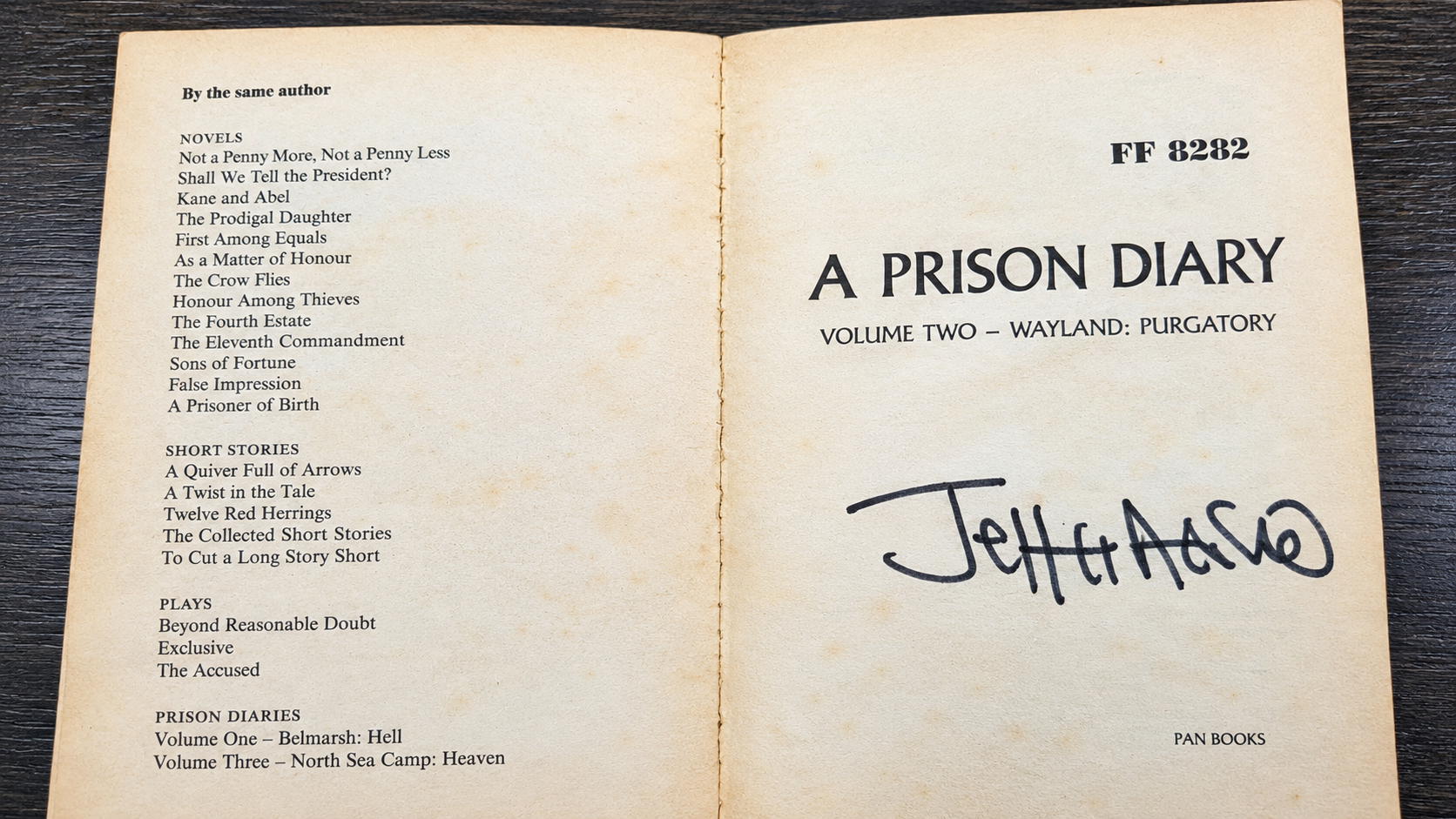
For someone who had admired his writing for years, meeting my favourite author was an unforgettable experience. I carried with me my copy of A Prison Diary: Volume Two – Wayland: Purgatory, and he graciously autographed it for me.
That signed book has remained one of the treasured possessions in my collection.
Today, his familiar signature on its ageing pages means infinitely more. It takes me back to that brief encounter in Mumbai and reminds me that sometimes the people we know through their words can, even through a short personal meeting, leave a lasting memory.
Jeffrey Archer and Chess — another special connection
There was another reason why Jeffrey Archer’s writing held a particular fascination for me.
As someone who has spent practically my entire life with chess, I was naturally delighted whenever I discovered the game appearing in the work of my favourite author!
And chess appeared in his stories more than once!!
Perhaps the best known to chess lovers is Checkmate, a delightful story in which a chess champion encounters an attractive young woman across the chessboard. He thinks he understands the game being played — both on and away from the board — only to discover that he himself has been an unsuspecting pawn in a much cleverer game.
It has everything one associates with Jeffrey Archer: confidence, calculation, deception and, finally, the unexpected twist.
But Checkmate was not his only brush with our game.
In The Red King, from Cat O’ Nine Tales, an English lord is desperately searching for the one missing piece required to complete a valuable antique chess set — the Red King. What follows, naturally, is a tale involving ingenuity, deception and another characteristically Archer conclusion.
There is also The Endgame, from To Cut a Long Story Short. Interestingly, the story opens over a chessboard, with Cornelius Barrington playing his old friend and solicitor Frank Vintcent and contemplating the approaching checkmate. The chess game becomes a fitting introduction to the much larger “endgame” that is about to unfold.
Perhaps chess suited Jeffrey Archer’s writing so naturally because the two have so much in common:
Strategy. Calculation. Deception. Sacrifice. The apparent advantage. The unexpected move. And finally, the twist that changes everything.
They are ingredients of a fascinating game of chess.
And they were ingredients that Jeffrey Archer mastered as a storyteller.
An email I never expected
In 2018, Indian Chess School was working on an ambitious project very close to my heart — the launch of a monthly chess magazine.
My dream was to create something more than a conventional magazine containing games, results and tournament reports. I wanted it to present chess in all its richness — its history, personalities, literature, culture, fascinating facts and, of course, instruction.
One of the proposed columns was called “Pen Power in Chess”, which would feature outstanding short stories and articles connected with chess.
There was one story I very much wanted to feature in our inaugural issue:
Jeffrey Archer’s Checkmate.
I decided to take a chance.
On 25 October 2018, I wrote to Sir Jeffrey through his official website. I introduced myself and Indian Chess School, explained our proposed magazine and requested permission to reproduce Checkmate.
I knew I was writing to one of the world’s most successful authors. I therefore sent the request more in hope than expectation.
What happened next pleasantly surprised me.
I received a prompt reply from his Personal Assistant, Alison Prince:
“Jeffrey is happy to give you permission to print his short story, CHECKMATE in this chess magazine only.”
The permission naturally came with the stipulation that the story could not be reproduced elsewhere or online and that the appropriate author and book credits should be given.
The email concluded simply:
“Best of luck with the magazine.”
Those may have been only a few words, but they meant a great deal to me.
Here was an internationally celebrated author, whose books I had read and collected for years, graciously agreeing to allow a chess magazine being planned by Indian Chess School in Mumbai to reproduce one of his stories.
I immediately wrote back expressing my gratitude and asking Alison to convey my sincere thanks to Sir Jeffrey.
I also mentioned something that made the correspondence particularly personal:
I had been fortunate enough to meet him in Mumbai and possessed an autographed copy of his A Prison Diary.
The magazine that never appeared
Unfortunately, despite all our preparations and enthusiasm, our proposed chess magazine could not take off in 2019.
And therefore, Checkmate was never published.
It has always remained one of those unfinished dreams.
But perhaps I should not call it unfinished.
The dream remains!!
Indian Chess School may yet bring out its chess magazine. And whenever that first issue eventually sees the light of day, it is my wish that Checkmate by Jeffrey Archer finds its rightful place in that inaugural issue, subject, of course, to reconfirming the necessary publication permission with his estate or publisher.
It would be a small tribute to the great storyteller who so graciously said “Yes” to us all those years ago.
A remarkable circle
Looking back today, I find the connections rather poignant.
I admired Jeffrey Archer as a reader.
I collected his books.
I met him personally in Mumbai and had my copy of A Prison Diary: Volume Two – Wayland: Purgatory autographed by him.
His experiences during imprisonment would later provide inspiration for stories in Cat O’ Nine Tales, the collection that includes the chess-connected The Red King.
And years later, through Indian Chess School, I approached him for permission to publish another of his chess stories — Checkmate — and received his gracious consent.
Literature and chess had somehow crossed paths repeatedly!!
For me, that makes the memory all the more special.
The storyteller lives on
To the world, Jeffrey Archer was one of the most widely read storytellers of his generation. His books travelled across countries, cultures and languages and entertained millions upon millions of readers.
To me, however, there will always be something more personal.
He will remain my favourite author — the writer whose books occupied a special place on my bookshelf; the celebrated storyteller whom I was fortunate to meet in Mumbai; the man whose autograph I proudly preserve; and the author who graciously permitted Indian Chess School to publish his wonderful chess story Checkmate.
The final page of his own extraordinary journey may have been turned.
But great storytellers never entirely leave us.
They remain on our bookshelves.
They remain in the characters they created.
They remain in the stories we read again and again.
And sometimes, they remain in something as simple and precious as a signature on an ageing page of a much-loved book!!
Rest in Peace, Sir Jeffrey Archer.
Your stories will continue to surprise, delight and inspire generations of readers — and somewhere, a game of Checkmate still awaits its first move in the pages of an Indian Chess School magazine.
Praful Zaveri