
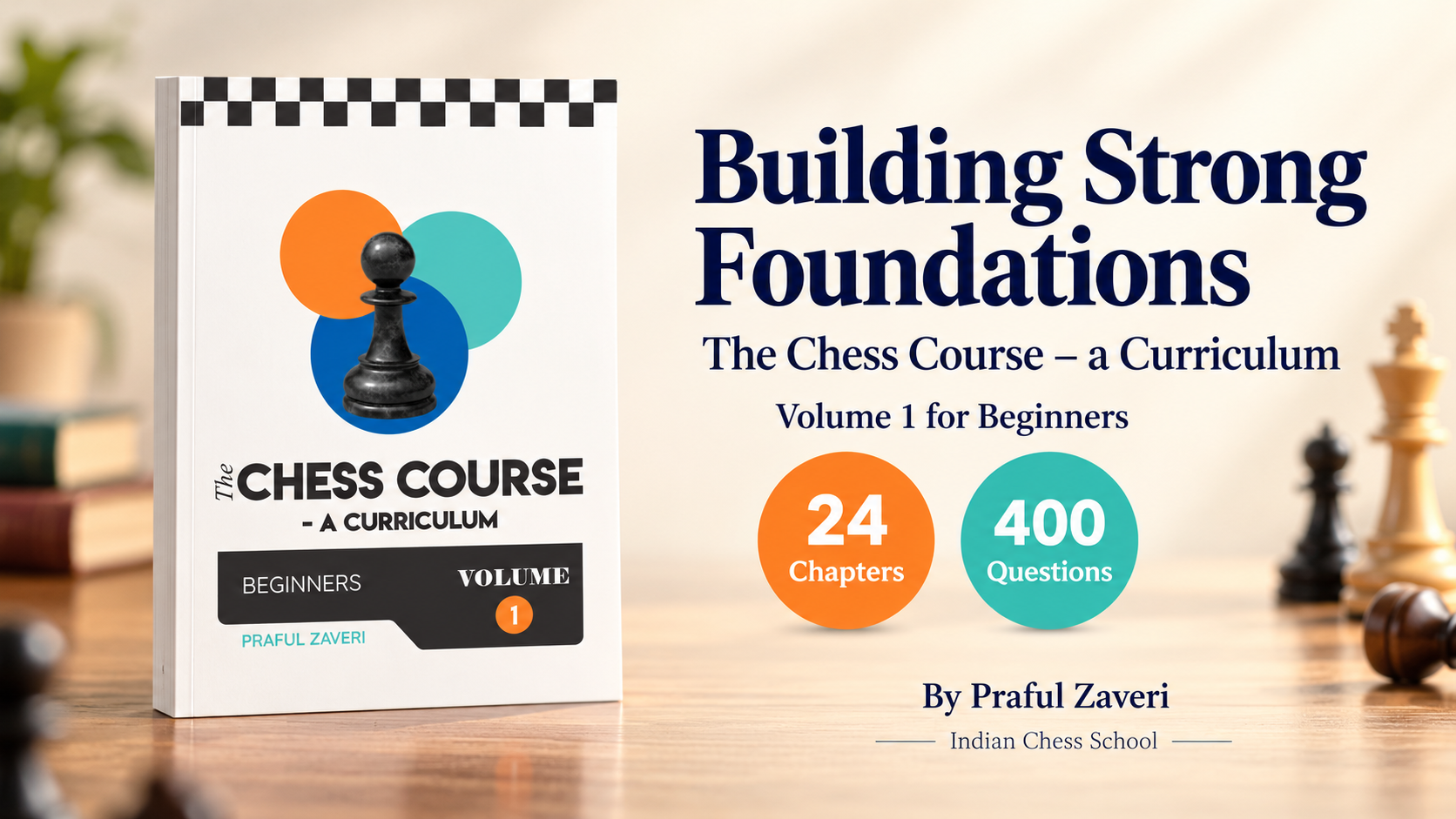

The Chess Course – a Curriculum, Volume 1: Building Strong Foundations Through Practice
The Chess Course – a Curriculum, Volume 1: Building Strong Foundations Through Practice
A child has just learned how a rook moves. The explanation seems clear, and the first few exercises have gone well. But can the child apply that understanding to a different position—where other pieces block the rook’s path or a capture becomes possible?
This is where practice becomes an essential part of learning.
The Chess Course – a Curriculum, Volume 1 for Beginners, by Praful Zaveri, is a workbook designed to accompany The Chess Course. With 24 chapters and 400 questions, it gives beginners additional opportunities to apply their lessons, strengthen their understanding and build a sound foundation.

Two Books, One Structured Learning Journey!
At Indian Chess School, the main book and the workbook have complementary roles.
The Chess Course—also referred to as the “Main Book” or “Parent Book”—provides the explanations, illustrative examples and initial exercises. Volume 1 extends that learning through additional solving.
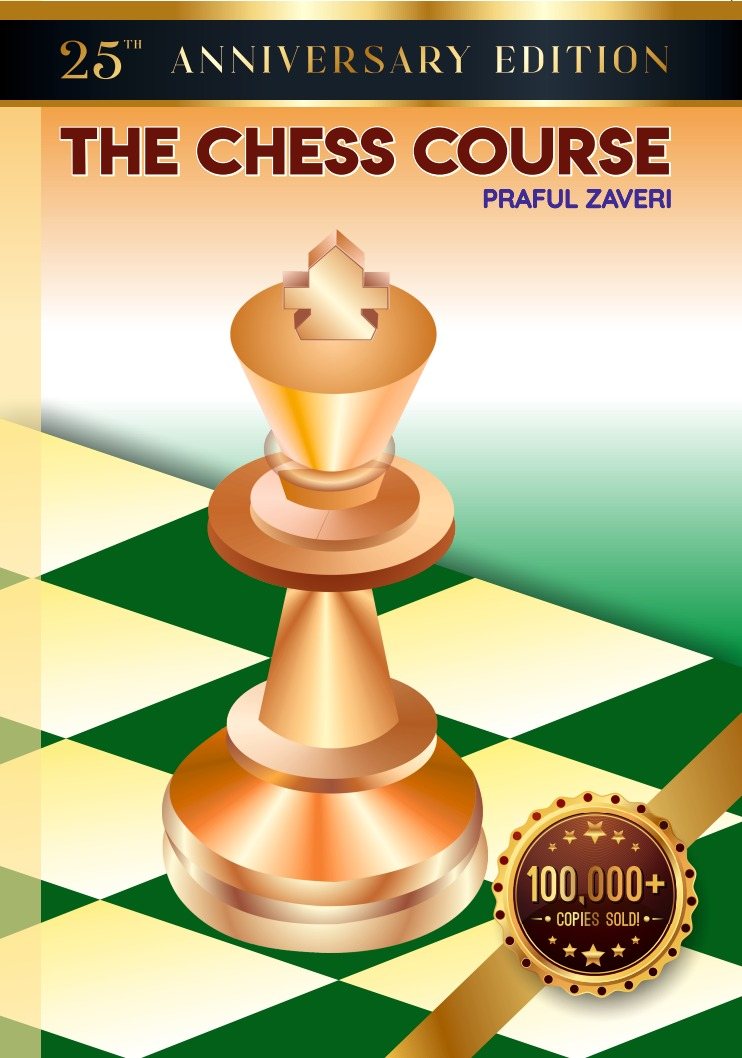
The corresponding beginner topics in the main book contain 164 questions. Volume 1 provides a further 400 questions, giving students more practice before they move ahead.
Both the teacher and the student use the two books, following a clear sequence.
- Understand the Lesson
The trainer first explains the relevant chapter from the main book, demonstrating the ideas and discussing them with the student.
- Attempt the Main-Book Exercises
The student completes the exercises that follow the explanation. These provide an initial opportunity to apply the lesson and reveal any difficulties.
- Reinforce the Learning with Volume 1
The student then attempts the corresponding exercises in the workbook. Different positions encourage the learner to think afresh and apply the same principles in varied situations.
- Review and Record Progress
The trainer checks the answers, discusses mistakes and awards marks for the chapter. The completion date is also recorded, creating a useful record of the student’s progress.
The Rook: Four Initial Exercises, Sixteen More Opportunities to Learn
Consider the lesson on the rook.
The main book introduces the piece and provides four exercises. Volume 1 follows this with 16 additional exercises on the same topic.
These include deciding whether a rook can reach a marked square and identifying the squares available to it in different positions.
A rook moves along ranks and files—but applying that rule requires the student to examine the position, notice obstructions and decide which moves are possible.
Working through varied examples helps the trainer check whether the student has understood the idea and can apply it independently.
What Does Volume 1 Cover?
The workbook takes beginners through the essentials of chess in a structured progression, including:
• The chessboard and chessmen.
• The movement of each piece.
• Algebraic chess notation.
• Recording moves and captures.
• Playing through a recorded game.
• Recording a game on a scoresheet.
• Castling and en passant.
• Check and the ways to respond to it.
• Recognising checkmate.
• The relative value of the chessmen.
These topics establish the knowledge a beginner needs to play and record a game correctly, while preparing for further study.
Making Progress Visible
The workbook also provides a way to follow the student’s development.
Marks help the trainer identify topics that need revision. Recording completion dates shows how the student is progressing through the course. The book includes a Course Completion Report and an Appraisal Report to support this process.
For parents, the completed workbook becomes a visible record of their child’s effort. They can see the questions attempted, the work assessed and the lessons completed.
For trainers, it supports a consistent approach to teaching, practice and review.
Learning from Mistakes
An incorrect answer can be a useful starting point for a conversation.
Did the student overlook a piece blocking the way? Confuse the movement of two pieces? Miss a threat to the king?
Discussing the reasoning behind an answer helps the trainer address the difficulty before introducing the next topic. Students also learn that checking their thinking and correcting mistakes are natural parts of learning chess.
The emphasis is on thoughtful solving, feedback and understanding.
A Strong Beginning, One Lesson at a Time
The Chess Course – a Curriculum, Volume 1 for Beginners, brings explanation, practice and assessment into a connected learning process.
The main book introduces the ideas. The workbook gives students more opportunities to use them. The trainer’s feedback helps turn that practice into understanding.
Together, the two books support the approach we value at Indian Chess School: teach clearly, practise thoughtfully and build strong foundations before moving forward.
Begin Your Child’s Chess Journey with Volume 1
Give your child more opportunities to practise, understand and build confidence with The Chess Course – a Curriculum, Volume 1 for Beginners.
Explore the book and order from the Indian Chess School online shop:
https://indianchessschool.com/product/the-chess-course-a-curriculum-volume-1/
For guidance on choosing suitable books for your child’s current level, please contact Indian Chess School.
Read our companion article on The Chess Course:
https://indianchessschool.com/the-chess-course-a-companion-for-your-chess-journey/
